
About Us
Outsource Marketer helps Houston businesses grow through strategic digital marketing. We specialize in SEO, Google Ads, Meta Ads, social media, website development, and email marketing, building tailored campaigns that attract qualified leads, improve online visibility, and deliver measurable business results.
Facebook Lead Ads vs Landing Pages: What Houston Businesses Should Test First
Facebook Lead Ads vs Landing Pages: What Houston Businesses Should Test First
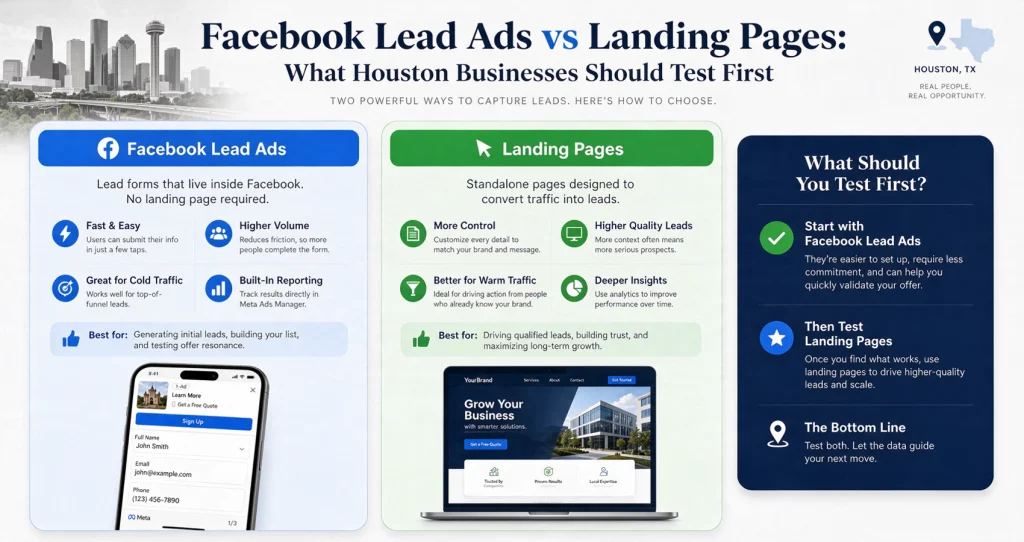
If you run paid social for a Houston business, you have probably faced this choice: send people to a Facebook lead form, or to a landing page on your website? Both can produce enquiries. They do it in different ways, and the right answer depends on your offer, your sales process, and how quickly you can follow up.
This guide explains how each option works, where each one tends to perform well, and how to run a fair test before you commit a large budget.
How Facebook Lead Ads Work
Facebook lead ads, also called Meta lead ads, let a person submit their details without leaving the app. When someone taps the ad, a form opens pre-filled with information from their profile, such as name, email address, and phone number. They can submit with one tap.
The main advantage is friction. Because the form is short and already filled in, many people complete it. That often produces a higher volume of leads for a lower cost per lead than a website can match, especially on mobile.
The trade-off is that you control very little. You cannot explain your service in depth, add trust signals such as reviews and case studies, or shape the visitor’s expectations before they submit. The lead also arrives inside Meta, so your follow-up process needs to pull leads in quickly and accurately. Leads that wait a day or two for a call often go cold.
How Landing Pages Work
A landing page is a dedicated page on your website built around one offer. The ad sends people to the page, the page explains the offer and why it matters, and a form or call button captures the lead.
Landing pages take more work to build and maintain. You need a clear headline, relevant proof such as testimonials or project photos, a form that asks for useful information, and tracking set up correctly so you can see which ads produced which leads. Page speed matters too, because slow pages lose visitors before they read the offer.
The advantage is control. A landing page can handle a complicated service, screen out poor-fit enquiries with qualifying questions, and build enough trust that the people who do submit are more ready to buy. It also stays with your business. If you change ad platforms later, your page and your lead data remain yours.
The trade-off is volume. Fewer people usually submit a landing page form than a lead form, because each extra step loses some visitors.
The Key Difference: Volume vs Quality
Most comparisons between these two options focus on cost per lead, and that is a useful starting point. But a cheap lead is not always a good lead. A plumbing company that gets forty form fills from people outside its service area has not gained much if only three of them are real customers.
For that reason, measure cost per qualified lead. Define what qualified means for your business before the test starts. It might mean the person lives within your service area, has a budget that matches your pricing, or has a specific problem you solve. Then count how many leads meet that standard for each option.
In many cases, lead ads win on volume and cost per lead, while landing pages win on qualified leads and close rate. The winner for your business is the one that produces the lowest cost per customer, not the lowest cost per form submission.
When Facebook Lead Ads Make the Most Sense
Lead ads tend to work well when:
- Your offer is simple and easy to understand at a glance, such as a free estimate, a booking, or a brochure download
- You can call or message new leads within minutes, while interest is still high
- Your sales team has the capacity to follow up on a high volume of enquiries
- You are testing audiences or creative and need fast feedback
- Your audience is mostly on mobile and would rather not leave Facebook to complete a form
Many Houston home service and local retail businesses fit this profile. A lead form can capture interest quickly when a homeowner needs help today.
When a Landing Page Makes the Most Sense
A landing page tends to work better when:
- Your service is high-value or takes time to understand, such as remodeling, medical services, legal work, or B2B consulting
- Trust matters a lot, so reviews, photos, certifications, and case studies need room to appear
- You need to ask qualifying questions before a lead reaches your team
- You want to send traffic from several channels, including Google Ads, SEO, and email, to one consistent page
- You plan to build retargeting audiences from visitors who did not convert
For Houston businesses in regulated or consultation-based fields, a landing page often produces better-prepared leads. The extra effort upfront can save your team hours of unqualified calls.
How to Test Both Fairly
A poorly designed test can give you a misleading answer. To compare the two options properly, follow these steps.
Keep the offer identical. If the lead form promises a free quote and the landing page promises a free consultation, you are testing two offers, not two formats.
Use the same audience and budget. Set up two ad sets with the same targeting, the same daily budget, and similar creative. Only the destination should change.
Run the test long enough. Two to four weeks is a practical minimum for most small budgets. Ending the test after three days usually reflects noise, not performance.
Track leads through to outcome. Tag each lead with its source. Record whether it was qualified, whether it booked a call or visit, and whether it became a paying customer. A spreadsheet is enough to start.
Decide the winner in advance. Agree on the metric before the test starts, such as cost per qualified lead or cost per booked appointment. That prevents you from choosing the result you like after the fact.
Once you have a winner, you do not have to abandon the other option. Many businesses run lead ads to build a volume of cheap awareness-stage leads and use landing pages for higher-value services. The two can work together.
Common Mistakes to Avoid
Several errors appear again and again in lead generation campaigns:
- Judging only on form fills. A high number of submissions means little if the leads never answer the phone.
- Using generic lead form questions. Asking only for a name and email gives your team little to work with. Add one or two qualifying questions, such as service area or project timeline.
- Sending traffic to a slow or confusing page. Test your landing page on a phone before you launch.
- Ignoring follow-up speed. Responding within the hour usually matters more than the choice of format.
- Changing too many things at once. If you alter the audience, creative, and page in the same week, you will not know what caused the result.
Setting Up Tracking From the Start
Whichever format you choose, tracking decides whether you can improve it. For lead ads, connect your CRM or use Meta’s lead export so each lead is linked to its ad set and creative. For landing pages, set up conversion tracking with Meta Pixel and Google Analytics, and send form submissions to your CRM with UTM parameters attached.
Without this setup, you will see a cost per lead but not a cost per customer, and the cheaper option may turn out to be the more expensive one.
Final Thoughts
Facebook lead ads and landing pages are not rivals so much as tools for different jobs. Lead ads deliver speed and volume with very little friction. Landing pages deliver control, trust, and better-qualified enquiries. For most Houston businesses, the best starting point is a fair test with one identical offer, one budget, and one agreed success metric.
Run that test for a few weeks, follow each lead through to a sale, and let the cost per customer decide. If you want help building a test or setting up the tracking behind it, talk to our team for a free consultation. You can also learn more about our Meta Ads services and website development.
Frequently Asked Questions
Are Facebook lead ads better than landing pages?
Neither is better in every case. Lead ads are faster to launch and often produce more leads at a lower cost per lead. Landing pages usually produce more qualified leads and give you more control over the message and tracking.
How do I test Facebook lead ads against a landing page fairly?
Use the same offer, audience, budget, and creative for both. Run the test for at least two to four weeks, and compare cost per qualified lead rather than the number of form fills.
Which option is better for a Houston service business?
Businesses with complex or high-value services often benefit from a landing page, since it can build trust before a visitor submits details. Businesses with simple offers and fast follow-up may do well with instant lead forms.
